The weather here in south Mississippi finally got cold, so I put on a jacket. In the pocket of that jacket, I found half of an index card with writing on both sides. One side has one of my signature to-do lists, complete with little square check boxes, more than half of which were still unchecked.
The other side has two lists about church ministry: “Stages of Church Distress” and “Scriptural Based Metrics for Church Health.” I am pretty sure I scribbled down the lists as I listened to a speaker at a recent revitalization meeting sponsored by Mississippi Baptists at Temple Baptist Church in Hattiesburg. And I am pretty sure the speaker was Jimbo Stewart. So I will credit him. It could have been Mark Clifton or Andy Addis, but I think it was Jimbo. I love these guys’ perspectives on church ministry.
What do you do with rich material that you scratched out on a scrap and don’t want to throw it away? Well, I decided to save it for perpetuity by turning it into a blog post (or two). So this is essentially a note to self, but if it can help you and your church, use it.
No one can deny that churches experience distress. Thom Rainer recently prognosticated that 2025 will likely see 15,000 churches in the U.S. close and 15,000 other churches no longer able to support a full-time pastor. Their pastors will be “co-vocational,” relying on income earned outside of the church.
Distressing trends like these have a beginning point that we identify as a “plateau” or a “decline.” Ups and downs are normal in churches, and the leadership’s response is critical. Will leaders address the dip? How will they address it? Will their response be healthy, leading to the bearing of fruit to the glory of God? Or will the decline continue unabated?
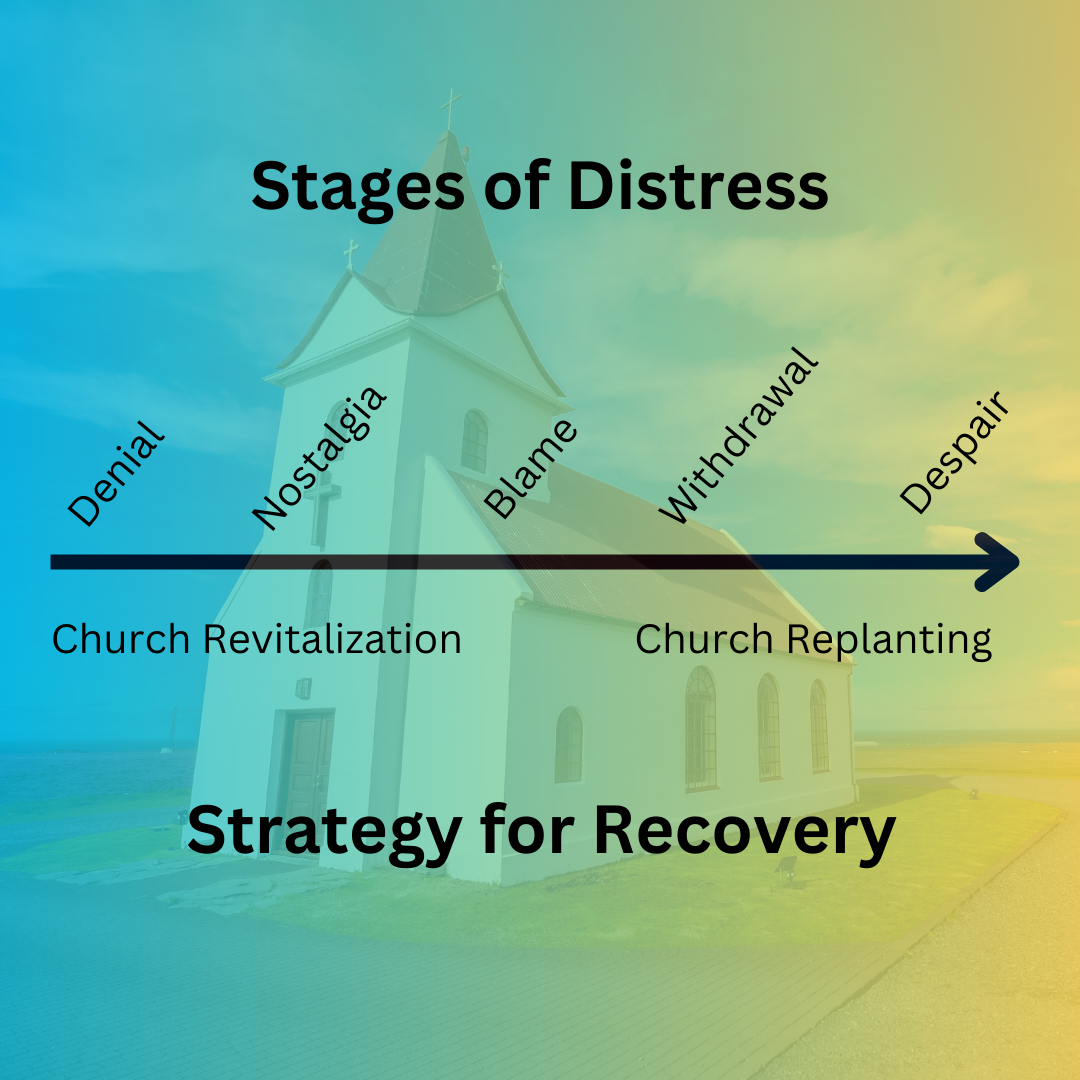
Below are five unhealthy responses to a downturn at church, presented as stages. If you have been in church for a long time, you will likely recognize all of these. All are common. None are acceptable.
Denial. “We’re okay.” This is an unhealthy initial response to distress. Sweep it under the rug. Do nothing. Ignore. Turn away. Deny. To do nothing is a choice that many churches and church leaders make. It’s too hard to change. Let’s just stay on the course that’s comfortable. In churches with a congregational polity, change requires educating the people before a decision can be made. That takes time. A long decision process usually ensues. Committees have to meet. Plans have to be drawn up. Change is slow. After 20 years in higher education, I can assure you that many people operate with a “do as little as possible” mentality. When it’s working for them, why change? “We don’t have a problem.”
Nostalgia. “Remember when . . .” When I visit a church’s website, I like to study their “About” section. Who are the staff members? What is their doctrinal statement? Sometimes in the About section, I find a history of the church. Most of them are about the good ‘ole days when the church was founded and those early years when the church was reaching the community and growing. Rarely does the history approach the current day with as much pizzazz and detail as those early days. Nostalgia is real. It’s comforting. It gives us warm fuzzies. But nostalgia can cloud vision, rob motivation, destroy unity, and kill progress. If we are looking backward, we are not looking ahead. Living in the present is a discipline and a virtue. The NT book of Acts is often seen as a manual for doing church well; biblical principles for church life abound on page after page. One of the ways I like to express the theme of Acts is this: “God is on the move, and the church is trying to keep up.” God is still on the move, but the church with an unhealthy nostalgia is missing out because they are not looking to see where He is leading now and in the future; they are pining for how He led in the past. “Church sure was better back then.”
Nostalgia can cloud vision, rob motivation, destroy unity, and kill progress.
Blame. The third stage is where things start to get nasty. Here is where the problem is apparent, but church members don’t want to take responsibility. Whose fault is it that our church is declining? What caused this undesirable distress? Blame is passed around like the gravy boat at a holiday dinner. “The pastor doesn’t visit.” “People today don’t take their kids to church.” “Members just aren’t as committed as they used to be.” There is enough blame to go around, but blame just divides. And divided houses don’t survive. The corrective to blame is taking responsibility is building unity around the things that matter. Blame points fingers when we need to hold hands. “I’m not the problem, you’re the problem.”
Withdrawal. As you might imagine, blaming one another leads into deeper distress for a church. Since blame is by nature divisive, when it runs its course it creates an “us versus them” atmosphere. A competition for power and control leaves winners and losers in its wake. Members start building walls instead of bridges. They stop being engaged, and they begin to withdraw. They withdraw from fellowship. They withdraw from worship. They withdraw from service. They withdraw from the mission. At this stage, extensive is the damage done. Members no longer invite their neighbors and acquaintances, because the church is not healthy. Evangelism loses its steam. Cliques form. Gossip and complaining spread. “I don’t want to see them.”
Despair. The final stage of distress is when members conclude “nothing can be done.” The whole church does not arrive at this stage at the same time. And some churches can stay at stage one, denial, despite having all the signs and symptoms of being here. Statistics show that urban churches get to this point more rapidly than rural churches. Why is that? Typically, the urban churches have more overhead, operating costs–larger buildings, bigger debt, more deferred maintenance–and their communities experience change at a quicker rate. The average rural church is more likely to be debt-free, have smaller buildings, and have members who can keep up the property. All they have to do is pay the utilities and pay the preacher. In such a scenario, the mission might be abandoned long before the church closes its doors.
But if a church, and especially its leaders, will acknowledge the distress signals and pivot in time, the mission can be renewed and the church restored to a fruitful and God-glorifying function. Mere recognition is not recovery; an accurate diagnosis is not a cure. Action must be taken.
The level of radical action is a correlation to the level of distress (see graphic below). At the denial and nostalgia levels, church revitalization is the best path forward. At the blame stage, revitalization may turn the church around, but the need to replant begins to come into view. When a church becomes withdrawn and despairing, church replanting is the answer.
Remember that the goal is not to keep a local church alive, but to advance the mission of reaching that community with the gospel of Jesus Christ. And that takes a healthy church.
 Bible and Ministry