I currently serve as Professor of New Testament at Luther Rice College and Seminary. I am available for pulpit supply and transitional (interim) pastoral ministry in south Mississippi.
One Command (28:19). Jesus is not complicating things. Even though he says a lot in these few verses, there is only one command. In grammar lingo, it is an imperative. “Make Disciples” – mathetusate – learner, follower, life patterned after another. Not mere “converts.” Everything is connected or contained in this command.
Three Courses of Action (28:19-20). These are participles, words that expand on the action of the main verb.
• “Going” – this is a lifestyle focus. “As you go.” “Wherever you go.” Take the gospel everywhere.
• “Baptizing” – incorporation into Christ and identification with the church. It takes a body of believers united in covenant to really produce followers of Christ.
• “Teaching to observe”- didaskontes – calling others to follow the Lord Jesus; the aim is obedience (see also Rom 1:5-6). Surrender allegiance to Christ above all. The aim is not merely hearing or knowing or memorizing or even proclaiming to others. The aim is obeying.
Four Convictions (28:18-20). ALL is the key word to each of these convictions. We need to hold dear to all of them if we want to be effective in Great Commission work.
• “All authority” – in heaven (eternal) and on earth (historical). If only in heaven, Christ’s authority would be no different than a myth. If only on earth, Christ’s authority would merely be like all the other rulers and spiritual leaders that have come before and since Him. But it is both. He is Lord over time and eternity, heaven and earth, the spiritual and the physical. And His being Lord of all takes away any absolute right another may claim to rule over us, including ourselves.
• “All nations [ethne]”. Our world is shrinking. We have unprecedented access all around the globe. You can call, text, email, and video chat with just about anyone in the world. And there are programs that will translate for you, breaking down the language barrier and opening the door much wider for the spread of the gospel. Here’s what we need to remember: Jesus said all nations, or better, all ethnicities. All people groups. We cannot evangelize only certain people.
• “All Jesus’ commands” We must teach and preach the whole counsel of God, the Bible. We have no right to pick and choose what we share or don’t share.
• “All the days” Knowing Jesus is with us is spiritually empowering. Two key thoughts related to His presence are being identified with Him and receiving His provision. We belong to God, and He will support. We have no need to fear, fret, or even to operate in our own strength.
1 Command, 3 Courses of Action, 4 Convictions. What about 2?
Two Choices (28:17).
• You can fearfully shrink back in “doubt” or you can boldly move forward in “worship.”
The weather here in south Mississippi finally got cold, so I put on a jacket. In the pocket of that jacket, I found half of an index card with writing on both sides. One side has one of my signature to-do lists, complete with little square check boxes, more than half of which were still unchecked.
The other side has two lists about church ministry: “Stages of Church Distress” and “Scriptural Based Metrics for Church Health.” I am pretty sure I scribbled down the lists as I listened to a speaker at a recent revitalization meeting sponsored by Mississippi Baptists at Temple Baptist Church in Hattiesburg. And I am pretty sure the speaker was Jimbo Stewart. So I will credit him. It could have been Mark Clifton or Andy Addis, but I think it was Jimbo. I love these guys’ perspectives on church ministry.
What do you do with rich material that you scratched out on a scrap and don’t want to throw it away? Well, I decided to save it for perpetuity by turning it into a blog post (or two). So this is essentially a note to self, but if it can help you and your church, use it.
Distressing trends like these have a beginning point that we identify as a “plateau” or a “decline.” Ups and downs are normal in churches, and the leadership’s response is critical. Will leaders address the dip? How will they address it? Will their response be healthy, leading to the bearing of fruit to the glory of God? Or will the decline continue unabated?
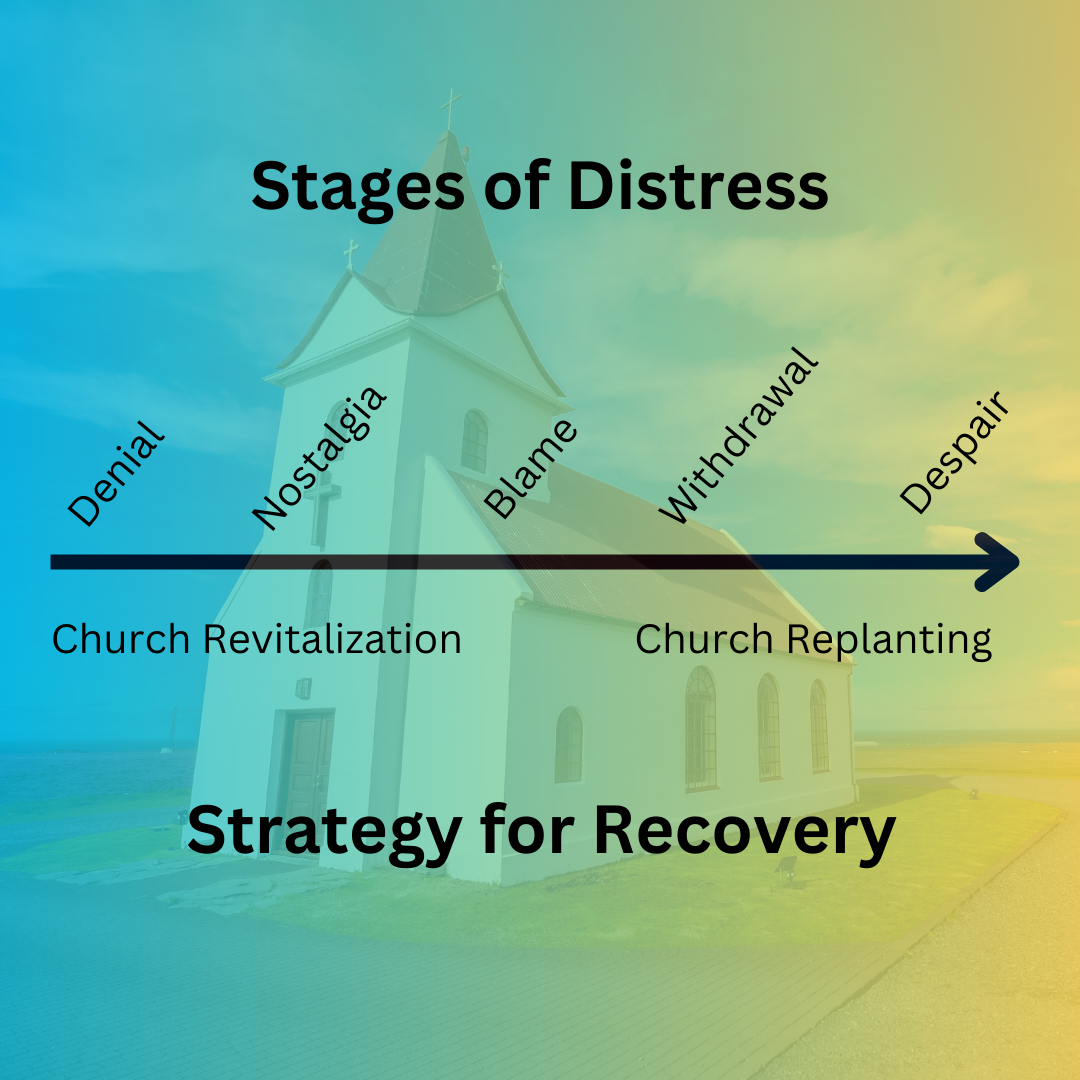
Below are five unhealthy responses to a downturn at church, presented as stages. If you have been in church for a long time, you will likely recognize all of these. All are common. None are acceptable.
Denial. “We’re okay.” This is an unhealthy initial response to distress. Sweep it under the rug. Do nothing. Ignore. Turn away. Deny. To do nothing is a choice that many churches and church leaders make. It’s too hard to change. Let’s just stay on the course that’s comfortable. In churches with a congregational polity, change requires educating the people before a decision can be made. That takes time. A long decision process usually ensues. Committees have to meet. Plans have to be drawn up. Change is slow. After 20 years in higher education, I can assure you that many people operate with a “do as little as possible” mentality. When it’s working for them, why change? “We don’t have a problem.”
Nostalgia. “Remember when . . .” When I visit a church’s website, I like to study their “About” section. Who are the staff members? What is their doctrinal statement? Sometimes in the About section, I find a history of the church. Most of them are about the good ‘ole days when the church was founded and those early years when the church was reaching the community and growing. Rarely does the history approach the current day with as much pizzazz and detail as those early days. Nostalgia is real. It’s comforting. It gives us warm fuzzies. But nostalgia can cloud vision, rob motivation, destroy unity, and kill progress. If we are looking backward, we are not looking ahead. Living in the present is a discipline and a virtue. The NT book of Acts is often seen as a manual for doing church well; biblical principles for church life abound on page after page. One of the ways I like to express the theme of Acts is this: “God is on the move, and the church is trying to keep up.” God is still on the move, but the church with an unhealthy nostalgia is missing out because they are not looking to see where He is leading now and in the future; they are pining for how He led in the past. “Church sure was better back then.”
Nostalgia can cloud vision, rob motivation, destroy unity, and kill progress.
Blame. The third stage is where things start to get nasty. Here is where the problem is apparent, but church members don’t want to take responsibility. Whose fault is it that our church is declining? What caused this undesirable distress? Blame is passed around like the gravy boat at a holiday dinner. “The pastor doesn’t visit.” “People today don’t take their kids to church.” “Members just aren’t as committed as they used to be.” There is enough blame to go around, but blame just divides. And divided houses don’t survive. The corrective to blame is taking responsibility is building unity around the things that matter. Blame points fingers when we need to hold hands. “I’m not the problem, you’re the problem.”
Withdrawal. As you might imagine, blaming one another leads into deeper distress for a church. Since blame is by nature divisive, when it runs its course it creates an “us versus them” atmosphere. A competition for power and control leaves winners and losers in its wake. Members start building walls instead of bridges. They stop being engaged, and they begin to withdraw. They withdraw from fellowship. They withdraw from worship. They withdraw from service. They withdraw from the mission. At this stage, extensive is the damage done. Members no longer invite their neighbors and acquaintances, because the church is not healthy. Evangelism loses its steam. Cliques form. Gossip and complaining spread. “I don’t want to see them.”
Despair. The final stage of distress is when members conclude “nothing can be done.” The whole church does not arrive at this stage at the same time. And some churches can stay at stage one, denial, despite having all the signs and symptoms of being here. Statistics show that urban churches get to this point more rapidly than rural churches. Why is that? Typically, the urban churches have more overhead, operating costs–larger buildings, bigger debt, more deferred maintenance–and their communities experience change at a quicker rate. The average rural church is more likely to be debt-free, have smaller buildings, and have members who can keep up the property. All they have to do is pay the utilities and pay the preacher. In such a scenario, the mission might be abandoned long before the church closes its doors.
But if a church, and especially its leaders, will acknowledge the distress signals and pivot in time, the mission can be renewed and the church restored to a fruitful and God-glorifying function. Mere recognition is not recovery; an accurate diagnosis is not a cure. Action must be taken.
The level of radical action is a correlation to the level of distress (see graphic below). At the denial and nostalgia levels, church revitalization is the best path forward. At the blame stage, revitalization may turn the church around, but the need to replant begins to come into view. When a church becomes withdrawn and despairing, church replanting is the answer.
Remember that the goal is not to keep a local church alive, but to advance the mission of reaching that community with the gospel of Jesus Christ. And that takes a healthy church.
Nothing will impact your spiritual growth more than reading the Bible consistently and with understanding. Have you been thinking about Bible reading plans and devotionals for 2024? I have. And here are some of the interesting helps I have found. Perhaps they will help you find a plan for your quiet time with the Lord.
Go to ESV.org and subscribe to a free reading plan or devotional. They offer a variety to devotional opportunities, some long term, some short term, some including videos. And here’s a bonus: they will email your subscriptions to you daily! How convenient!
Download a free version of Logos Bible software (mobile app, desktop app, web app). Yes, there is a free version with nearly $800 worth of resources including five different versions of the English Bible, two audio Bibles, a study Bible, a couple of commentaries, and one of the best devotionals ever written: Morning and Evening by Charles Spurgeon. Get the app for iOS here: https://apps.apple.com/app/id336400266. Visit www.logos.com for the other versions of the software.
One of my favorites is the free Study Bible app by Grace to You. It includes three devotionals and one reading plan. The devotionals are Drawing Near, Strength for Today, and Daily Readings from the Life of Christ, all written/compiled by John MacArthur. The reading plan (Daily Bible) provides the references for a plan similar to M’Cheyne’s plan to read through the Bible in a year. Get the iOS app here: https://apps.apple.com/app/id992237916.
For those of you who prefer to read ink on a page more than pixels on a screen, you can find Bible reading plans and print devotionals at a Christian bookstore. Some study Bibles have a reading plan in their appendices. I recommend reading through the Bible in a year or two and utilizing a devotional such as Spurgeon’s Morning and Evening or Faith’s Checkbook. Another classic is My Utmost for His Highest by Oswald Chambers. The two I mentioned above by John MacArthur, Strength for Today and Drawing Near are very good and available in print as well.
Ligonier Ministries has a helpful collection of Bible reading plans in PDF format that you can download and print. Click here to visit their page.
Spending time in the Word of God on a regular basis is the best recommendation I can give you. No discipline is more life-changing. If you miss a day, don’t give up or beat yourself up. Just start back. All of us miss days. If my goal is to read through the Bible in a year, what difference does it really make if I read it through in 365 days versus 400 days or 750 days? I still will have reached my goal. Truly though, that’s not the real goal. The real goal is to spend time hearing from the God of the universe who loves you so much that he sent His own Son to make you holy (Col. 1:22).
Widely known and accepted is the reality that the average age of pastors is increasing because fewer and fewer young men aspire to the pulpit. This pastoral shortage is widely documented, and efforts are underway to address the problem. For example, Southern Baptists have created a resourceful website at callingouthecalled.com.
Is there anything we can do to address this issue? On the one hand, isn’t that God’s business? Should we really even be meddling in the lives of men, urging them to consider the call to preach?
Yes and no.
The pressure to pastor should never come from us. If a man can be content spending his life in another vocation, he should not pursue ministry. First Timothy 3:1 is the first qualification: desire. He must want to preach and serve the church.
On the other hand, are there things we can do to either encourage or discourage a man considering the ministry? Yes, there are. And I think current pastors are key.
First, pastors set an atmosphere open to ministry exploration. Ask younger pastors today, and they will likely tell you about an influential pastor who set an atmosphere at their church that resulted in many men responding to the call to ministry. There is no doubt that God uses His men to influence the next generation of His men. They model what it means to love God, love His Word, love their families, and love His church.
Last year, I preached the funeral of G. A. McCoy, my relative and a long-time pastor in Mississippi. Many men surrendered to preach under his influence. He was well-known for creating an atmosphere in which vocational ministry was viewed as a treasure, an admirable vocation, and a viable and noble calling.
How can we do that? One, don’t denigrate the role of a pastor. Pastors, don’t complain or grumble. Don’t tell horror story after horror story of life as a pastor. Perhaps we are all guilty of that to some extent, but we need to stop (Phil. 2:14). That sets a bad atmosphere and provides an incomplete picture of vocational ministry.
Another basic key to setting an atmosphere is to invite men to respond to the call to preach. Most invitations are directed toward salvation, baptism, and church membership. Include in your invitations a call to pursue ministry and missions. Make that a staple in your preaching. Pastors, set an atmosphere in your church of respect and honor for the pastorate.
The other way to encourage more openness to vocational ministry is apprenticeship. How does a man learn a trade? He apprentices under a master. Our current educational philosophy has unfortunately moved away from apprenticeship; it is a virtually lost model. Instead, we send men off to Bible college or seminary and expect the school to prepare them. I am definitely not discounting that, but let’s be real, it isn’t enough. It really isn’t primary. We need partners all throughout our journey as pastors. At the beginning, we especially need help getting started on the right foot.
Pastors have the opportunity to pour into a young man who will be a pastor to the next generation. In times past, that has looked like the youth pastor (Pastor, Jr.). Now, thankfully, churches are seeing the need to start mentoring programs and residency programs that invest in and test the fitness of aspiring ministers.
Let the young guns shadow you, pastor. Let them have a shot at teaching and preaching. Take them to meetings. Take them on visits to home and hospital. Consider this well-known process known as the stages of apprenticeship:
I do; you observe
I do; you assist
You do; I assist
You do; I observe
Do you have men in your congregation whom God may be calling to ministry? Be the key to setting an atmosphere and offering apprenticeship. Need some help? Attend the Discern the Call event in October 2023. If you can, bring a potential pastor. If not, come be inspired and trained by experienced practitioners on how to call out the called.

 Bible and Ministry